
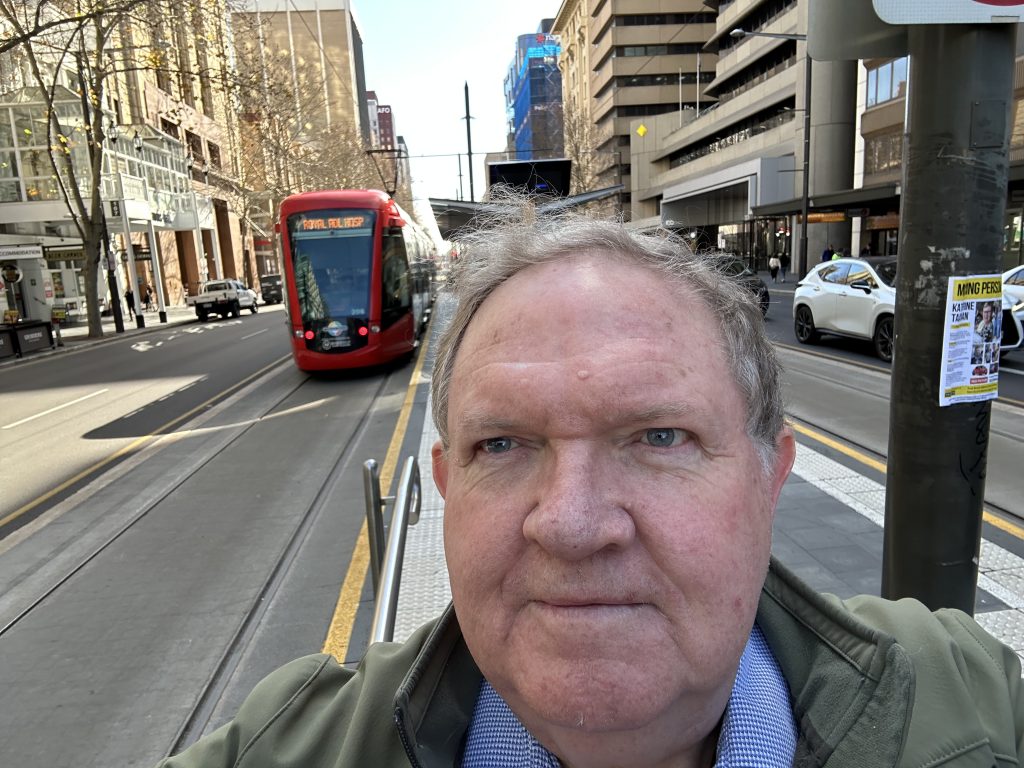
Building Better Communities Through Transport Scott Elaurant
Transport shapes communities in ways that extend far beyond how we get from one place to another. The roads, railways and walking routes we build influence where people live, how towns grow, how much time we spend travelling and how easily we participate in everyday life.
Transport engineer and planner Scott Elaurant has spent decades observing these changes across Queensland. In this episode of Streets and People, he joins Wendy Nash to explore how historical transport networks shaped our towns, why expanding roads can encourage more driving and what his own engineering experience has taught him about creating safer, more liveable communities.
Their conversation takes us from the horse-drawn coaches of early Queensland to contemporary debates about road design, transport economics and the importance of local journeys.
3 key insights
- Transport shapes communities over generations. The spacing of early Queensland towns reflected how far people could travel by horse-drawn coach. Railways and motor vehicles subsequently changed settlement patterns, allowing people to travel further and cities to expand.
- Local journeys matter as much as major transport connections. Scott argues that transport planning needs to give greater attention to journeys within communities, including trips to schools, shops, services and recreational activities.
- Better economic assessments can support better transport decisions. When road safety, health, walking and other wider impacts are considered alongside congestion and travel time, smaller local improvements may offer substantial benefits.
1 surprising moment
Scott recalls working on a road design that narrowed footpaths along Caboolture’s King Street to accommodate an additional traffic lane. The change reduced congestion temporarily, but traffic growth eventually overtook the extra capacity. The reduction in footpath quality, however, remained. Looking back, Scott recognises that the design delivered a short-term improvement in traffic capacity at a lasting cost to pedestrians.
1 real-world example
Caboolture provides a particularly relevant example of how transport shapes communities. Scott remembers when Caboolture was a separate town, surrounded by undeveloped land between it and Brisbane. As transport connections improved and suburban development expanded, that separation gradually disappeared. Yet Caboolture remains a community with its own schools, shops, workplaces and recreational destinations. Scott argues that making journeys within Caboolture easier and safer deserves greater attention.
Contents
- How transport shapes communities over time
- Cobb & Co and Queensland’s early towns
- Marchetti’s constant and the time we spend travelling
- Induced demand and expanding cities
- Why local journeys matter
- How transport shapes communities through investment decisions
- The economic importance of road safety
- Local government and everyday transport
- Lessons from Caboolture’s King Street
- Professional responsibility in road design
- Learning from the past
How transport shapes communities over time
Scott’s interest in the relationship between transport and urban development grew throughout his career in civil engineering, traffic engineering and transport planning. After completing his engineering degree in the 1980s, he worked in consulting before joining Queensland’s Main Roads. At the time, Brisbane was expanding rapidly, with suburban development spreading towards places including Caboolture, Beenleigh and Ipswich. Scott worked in transport modelling, examining how changes to roads and transport networks influenced traffic movement.
He jokingly describes the work as playing SimCity in real life. But the modelling revealed something important. Transport infrastructure does more than accommodate existing journeys. It also influences where future development occurs and how people choose to travel. Scott saw this relationship through his work in Brisbane, Cairns, Gympie and the Sunshine Coast. He remembers when communities such as Caboolture and Strathpine were clearly separated from Brisbane by stretches of undeveloped land. Today, much of that separation has disappeared.
For Scott, understanding how transport shapes communities requires looking at how those places developed in the first place.
Cobb & Co and Queensland’s early towns
One of the most interesting parts of Scott’s conversation concerns the distance between early Queensland settlements. Before railways and motor vehicles became widespread, horse-drawn coaches provided important transport connections. Scott explains that towns developed at intervals reflecting how far coaches could conveniently travel. These stopping places offered accommodation, food, stables and opportunities to water and rest the horses. Over time, they contributed to a recognisable settlement pattern across parts of eastern Australia.
Scott points to the chain of communities extending north from Brisbane towards Gympie. Their locations reflected both travelling distances and geographical obstacles. Rivers were particularly important because crossing them could be difficult before major bridges were constructed. When railways arrived, the relationship between distance and settlement began to change. People could travel further and more quickly. Some established towns continued to grow, while smaller intermediate settlements became less significant.
Motor vehicles accelerated that process. Scott describes how improved road transport eventually allowed people to travel approximately 100 kilometres in an hour on a highway. Growth increasingly concentrated around larger centres separated by greater distances. The relationship between Brisbane, the Sunshine Coast and other regional centres illustrates this changing pattern. Transport shapes communities partly by determining which places are conveniently accessible and which become relatively isolated as travel patterns change.
Scott’s central observation is that the historical spacing of towns was closely connected to the transport technology available at the time.
Marchetti’s constant and the time we spend travelling
Scott introduces Marchetti’s constant to explain another aspect of how transport shapes communities. The concept concerns the relatively consistent amount of time people spend travelling, despite changes in transport technology. Scott describes historical settlements around ancient Athens and Rome, where walking distances influenced how far people could live from the places they worked. Farmers needed to reach their fields on foot, while residents also needed access to the activities and amenities of their settlements.
The distances people could conveniently travel helped determine the geographical extent of those communities. As transport technology improved, people could travel much further within a similar amount of time. The distance changed, but the amount of time spent travelling remained comparatively consistent. Scott connects this idea to contemporary discussions about 15-minute cities and 20-minute neighbourhoods. He argues that these concepts reflect something fundamental about everyday life: people have limited time available for travel alongside work, family responsibilities, recreation and other activities.
Scott recalls a Brisbane study from the late 1990s examining people whose commuting times exceeded approximately 40 minutes each way. He describes a substantial proportion changing their home or employment circumstances within a year. For households balancing several responsibilities, lengthy daily journeys can become difficult to sustain.
The relationship between travel time and urban growth helps explain why transport shapes communities differently as technology changes. Faster transport allows people to live further from their destinations, but it does not necessarily mean they spend less time travelling.
Induced demand and expanding cities
The conversation then turns to induced demand. When additional road capacity makes driving quicker or more convenient, people may respond by driving further or making more journeys. Scott explains that this behaviour is consistent with a broader economic principle: when something becomes easier or cheaper to use, people often consume more of it. Transport provides a particularly clear example because changes in travel behaviour can be measured.
Scott connects induced demand to the idea of a travel time budget. If road improvements reduce journey times, people may use that additional capacity to travel greater distances. Housing and employment can become more widely separated, encouraging further suburban expansion. As traffic volumes grow, the additional road capacity may eventually become congested again. This creates a challenge for transport planning. A road improvement may initially reduce congestion while contributing to longer-term growth in traffic and travel distances.
Scott’s experience suggests that understanding how transport shapes communities requires examining these wider effects rather than considering individual road projects in isolation.
Why local journeys matter
Scott argues that transport planning has historically placed considerable emphasis on commuting, particularly journeys into major city centres. Those journeys remain important, but they represent only part of everyday travel. People also travel to schools, shops, medical appointments, sporting activities and other destinations. Even among people travelling to work, many are employed outside central business districts.
Scott points out that a large proportion of Brisbane’s workforce travels to destinations other than the CBD. Planning primarily around journeys into central Brisbane therefore overlooks many transport needs.
Caboolture provides a useful example. Although it has become part of the larger Brisbane urban area, it remains a community with its own employment, education, shopping and recreational destinations. Scott argues that transport planning needs to recognise Caboolture as a community in its own right. He suggests that greater attention to local journeys could make everyday life easier for residents. The conversation also considers how assumptions about household travel have changed.
Traditional approaches often reflected a household in which one person commuted to work while another remained closer to home. Scott observes that employment patterns and household responsibilities are changing, making it important to reconsider those assumptions. Wendy raises another limitation: Census journey-to-work information excludes many journeys undertaken by people who are not travelling to paid employment. This includes volunteers, carers, retirees and others whose transport needs remain important.
Together, these observations raise questions about whether existing transport data adequately reflects everyday life. Understanding how transport shapes communities requires recognising the full range of journeys people make.
How transport shapes communities through investment decisions
Scott’s career also includes transport economics and the preparation of business cases. He discusses the benefit-cost ratio, a measure used to compare the estimated benefits of an infrastructure project with its costs. Scott acknowledges that economic assessment methods have improved considerably during his career. However, he also describes occasions when decisions about projects had effectively been made before the economic analysis was completed.
In those circumstances, the benefit-cost ratio risked becoming a procedural requirement rather than a meaningful contribution to decision-making. Scott believes economic assessment can be valuable when undertaken carefully and with integrity. The important question is what gets counted.
Historically, transport assessments placed considerable emphasis on travel time savings. Reducing travel time remains valuable, particularly for people balancing employment, education and family responsibilities. However, Scott explains that economic assessments increasingly recognise other benefits and costs. These include physical activity, health outcomes, pollution, road crashes and the wider consequences of transport decisions.
Walking provides an interesting example. Scott discusses work in New South Wales examining the economic value of walking, including the health benefits associated with regular physical activity. These benefits can be substantial, even when they are less immediately visible than the travel time savings associated with road upgrades. Scott wonders whether governments might sometimes achieve better value by investing in numerous smaller projects across regional and town centres rather than concentrating expenditure on major infrastructure.
These decisions matter because transport shapes communities through the priorities reflected in public investment.
The economic importance of road safety
One of the more sobering parts of the conversation concerns the economic cost of road crashes. Scott explains that the consequences extend far beyond vehicle damage and immediate medical expenses. Serious crashes can result in long-term health problems, lost employment, ongoing treatment and considerable suffering. Some people involved in serious crashes never return to their previous employment.
Scott refers to Australian estimates from 2016 that placed the annual cost of road crashes at approximately $31 billion, compared with approximately $16 billion for congestion. These are historical estimates discussed during the interview.
Scott finds the comparison significant because substantial public expenditure is directed towards reducing congestion, while the wider economic burden of crashes may be considerably greater.
He believes that more comprehensive economic assessments could influence transport investment decisions. When road safety, health and other consequences receive appropriate attention, projects that improve walking and cycling conditions may become more attractive investments. The way transport shapes communities is therefore connected to how governments measure the benefits of different infrastructure choices.
Local government and everyday transport
When Wendy asks what residents can do to improve transport conditions for their families, Scott turns his attention to local government. Having spent much of his career working with state governments, he reflects that local government may not always have received sufficient attention. Yet councils make many decisions that influence everyday journeys. These include local street design, pedestrian crossings, footpaths and access to community destinations.
Scott encourages residents to engage constructively with their councillors. He gives an example of a choice between widening a road near a commercial development and installing additional pedestrian refuges that make it easier for residents to cross. The pedestrian improvements might provide substantial benefits for local journeys. Scott also emphasises the social value of walkable neighbourhoods. When people can move comfortably around their local area, they have more opportunities to encounter neighbours, participate in activities and feel connected to their surroundings. He encourages residents to explain what they need from their streets and ask councils to make local travel easier and safer.
These everyday decisions demonstrate how transport shapes communities at a neighbourhood level.
Lessons from Caboolture’s King Street
Scott’s reflections on King Street provide a particularly memorable example of how engineering decisions can have lasting consequences. Earlier in his career, he worked on planning studies that included roads through Caboolture. He recalls preparing a design that reduced footpath space to accommodate an additional traffic lane near the King Street and Beerburrum Road intersection.
The intention was to reduce congestion. Scott explains that the change achieved that outcome temporarily, before increasing traffic volumes recreated the problem. The narrower footpath, however, remained. Looking back, he recognises that the project delivered a short-term improvement in traffic capacity at the expense of lasting pedestrian amenity.
Scott shares the experience openly as a lesson for contemporary engineers and planners. He encourages them to protect footpath space and recognise the long-term benefits of walkable communities. The example also demonstrates how professional understanding can change. A design approach that once appeared reasonable may be reconsidered as better evidence and guidance become available.
For Scott, the King Street experience illustrates how transport shapes communities through decisions that may initially appear to concern only traffic capacity.
Professional responsibility in road design
Scott offers practical advice to engineers and planners, particularly those working in organisations where increasing road capacity remains a dominant priority. His first recommendation is to understand and follow current standards and good practice. He emphasises the professional responsibility to consider the safety of everyone who may use a road, including pedestrians and cyclists. Scott notes that guidance has improved considerably during his career.
When he began working, minimum traffic lane widths were clearly established, while pedestrian infrastructure did not always receive equivalent attention. Today, engineers have access to more comprehensive guidance on pedestrian and cycling facilities and Safe System design.
Scott highlights 2 important approaches to reducing risk in urban areas: separating pedestrians and cyclists from motor vehicles, or reducing vehicle speeds. He acknowledges that junior professionals may face pressure to follow established practices or support decisions made by more senior people. His advice is to remain familiar with current guidance and continue advocating for sound professional practice. He also discusses work within Engineers Australia to develop guidance and discussion papers that support engineers in understanding their responsibilities.
The broader message is that professional knowledge carries responsibilities, even when changing established approaches is difficult.
Learning from the past
Scott ends the conversation by reflecting on the changes he has witnessed throughout his career. He welcomes the greater public involvement now evident in discussions about transport infrastructure. Decisions that were once largely confined to technical specialists are increasingly debated within communities. Scott sees this as a positive development, provided people have access to good information about the consequences of different choices. He also recognises that transport design standards and professional expectations have evolved. Approaches that were widely accepted in the 1980s may no longer reflect contemporary knowledge about safety, accessibility and community needs. Scott encourages decision-makers to recognise those changes rather than relying on familiar solutions from earlier decades.
His reflections offer a constructive perspective on how transport shapes communities. The history of Queensland’s towns shows that transport decisions can influence settlement patterns for generations. His experience on King Street demonstrates that even relatively small design choices can leave lasting effects. At the same time, better evidence, improved design guidance and greater community participation provide opportunities to make different decisions. For Scott, the aim is to use that knowledge to create places where everyday journeys are easier, streets are safer and communities can thrive.
The transport systems we build today will help shape how future generations live. Understanding the past gives us a valuable starting point for making those choices well.
A challenge for lawyers and engineers
Following our conversation, Scott offered a question for lawyers, engineers and transport professionals to consider.
Scott points out that Registered Professional Engineers of Queensland (RPEQ) and Chartered Professional Engineers (CPEng) have professional responsibilities concerning the safety of people who use the infrastructure they design.
He proposes the following scenario.
A councillor asks an engineer employed by a local council to upgrade a road to accommodate growing traffic volumes. The proposal involves widening an existing 2-lane road to 4 lanes.
The engineer designs the widened road in accordance with relevant Austroads road design guidance for motor vehicle safety. The additional lanes increase capacity and initially reduce congestion, although traffic growth may eventually absorb that capacity. However, the engineer has not considered more recent Austroads and state road authority guidance concerning Safe System design and safe pedestrian and cycling facilities. As a consequence of the widening, the footpath is reduced below minimum design standards. Pedestrians also find it more difficult to cross the wider road.
Scott’s question
Has the engineer fulfilled their legal duty of care for public safety by designing a road that meets the relevant requirements for motor vehicles, while failing to adequately consider the safety of pedestrians and cyclists?
The scenario raises questions about how professional obligations apply when road capacity improvements create additional difficulties for other road users.
Scott invites lawyers and engineers to consider these responsibilities, particularly where established approaches to road design may conflict with more recent safety guidance.
The question is open for discussion. Determining whether a legal duty has been breached would depend on the applicable law, professional obligations and circumstances of the particular project.
Ideas we discussed in the episode
Marchetti’s constant is discussed here: https://michael-k-goff.github.io/2025-07-05-marchetti/
The role of Cobb & Co Coaches in the early history and settlement patterns of Queensland are discussed here (some great historic photos and anecdotes): https://www.slq.qld.gov.au/blog/lights-cobb-and-co-coaching-between-brisbane-and-gympie-1860s-0
Early settlement patterns are discussed more generally here. Later the roles of coastal shipping and rail transport were crucial. But you can still see the same pattern in the average separation between early communities in each state. https://www.bitre.gov.au/sites/default/files/report_136_CHAPTER_3_WEB_FA.pdf
Podcast theme music: Doctor Yes | Yari | Bensound
GetAroundCaboolture.au
